Showing posts with label Maria Fontaine. Show all posts

6 May 2011

Judge who convicted man for child sex blames his childhood in The Family International for skewed view on sexuality


Herald Sun   -  Australia    May 6, 2011

Man's child sex addiction blamed on religious cult upbringing

Tony Keim  |  From:The Courier-Mail


A FORMER member of religious sect that condoned pubescent child sex counted eight schoolgirls among his more than 100 sexual conquests who he met via an adult internet chat room, a court has been told.

The Brisbane District Court was told Nathaniel Francis Enright, 30, tried to procure a child as young has 12 for sex and actually molested or had sex with seven other girls - aged 14 and 15 - that he met “on-line” between November 2008 and February 2009.

The court was told Enright was raised as a member of the "strict religious group'' The Family International - known also as the "Children of God'' - and as a result had a "skewed view'' on who he could have sexual contact with.

Barrister Angus Edwards, for Enright, said his client, who left the sect at the age of 16, was raised in an environment which condoned sexual contact between children once they had reached puberty.

Enright, a former airline employee, was today jailed for five years and placed on two year's probation after pleading guilty to 51 criminal charges - including five of taking away a child for immoral purposes and three of having sex with them.

However, the sentence imposed will see Enright, who has already spent 15-months in pre-sentence custody, released on February 6 next year.

Enright, who was at the time aged between 28 and 29, also pleaded guilty to more than 30 counts of indecent treatment or exposing a child under 16 to indecent material or act, and eight of using the web to procure or groom underage children for sex.

Prosecutor David Meredith said Enright, who was at the time based in New Zealand, met all of his victims via internet chat rooms.

He said Enright would engage in explicit sexual dialogue with the children and encourage them to meet for physical encounters.

"The combination of (Enright's) offences is quite extraordinary,'' Mr Meredith said.

"(Enright was) quite persistent and there is an extraordinary number of contacts ... (with underage) girls willing to meet up with him.''

Mr Edwards said Enright met the girls via a chat room designed for people aged 18 and over - suggesting the children would have to have logged in as being adults themselves.

"(Enright claims) there were more than 100 women he met up with and had sexual (encounters),'' he said.

Mr Edwards tendered a psychological report which asserted Enright was not a pedophile, but that he simply had a compulsive addiction to sex as the result of his religious up-bringing.

The court was told even during his time in prison Enright's sexual proclivities compelled him to pleasure himself on a daily basis.

Judge Nick Samios, in sentencing Enright, said: "You procured some of these young girls to engage in (actual) sexual contact.''

"You appear to have a skewed view of who you could have sexual contact with because of your (religious) up-bringing ... (and you are) addicted to sex.''

Judge Samios said that addiction to sex resulted in Enright taking "opportunistic and indiscriminate'' steps to secure sexual partners.


This article was found at:


RELATED ARTICLES  ON THIS BLOG:


Denied an education in The Family International abuse survivor explains how she wrote her first novel


Novelist describes how she survived childhood of abuse and neglect growing up in The Family International, aka, Children of God


Author's debut novel draws on personal experiences growing up in abusive Children of God cult, a.k.a. The Family International


UK survivor confirms mother's fears about abusive cult The Family International that tried to recruit her teen daughter


Fugitive leaders of The Family International found hiding in Mexico after former members sought psychological help


Family International a.k.a. Children of God: Once dismissed as 'sex cult,' tiny church launches image makeover


17 Mar 2011

Denied an education in The Family International abuse survivor explains how she wrote her first novel


The Huffington Post - March 11, 2011

On Writing 'The Informationist' and Coming from a Cult Background


by Taylor Stevens


I'm often asked which came first, plot or character. The answer should hint toward how clueless I was when I first set out to write: I had no plot, or characters--not even an idea of the story--only the place.

I'd spent four years living in Africa--over two of them in Equatorial Guinea--and when I made the decision to "write a book," all I knew was that it was going to be fiction, and I would set a good portion of it on Bioko Island, off the west coast of Africa. At the time, I didn't quite understand the concept of genre, but I figured my book should be something like what Robert Ludlum wrote. Turns out, Robert Ludlum wrote thrillers, and now, so do I.

It might be easy to think that I'm self-deprecating and attempting to be funny, and while I would happily settle for funny, the truth is, I really was that clueless.

My life, up until that point, had been anything but traditional. Born and raised in the Children of God, an apocalyptic religious cult that believed education beyond 6th grade was a waste of time, I'd lived on four continents and knew how to cook for a hundred people at a go, but only had a splotchy grade-school education that left me unfamiliar with a few fundamental concepts. Like the parts of speech, for example, and proper punctuation, and math beyond decimals: on the whole, not very helpful for entering the real world as a mother of two babies, and trying to forge a career.

One of the few upsides to coming from nowhere and knowing little, is being acutely mindful of your own ignorance. That was me: determined to write, fully aware that I knew absolutely zero about publishing or for that matter, about writing fiction. But I did know how to use a search engine. The Internet was my lifeline to knowledge, and a used writing guide my trusty Bible.

I wrote more--and re-wrote a lot. I was halfway through the first draft of THE INFORMATIONISTby the time I finally began to grasp what my writing guide had taught; half-way through, I'd found my voice, but more triumphant it seemed at the time, I finally understood what the heck they meant when they kept going on and on about that thing called "voice."

And then, two years into the writing process, one day to the next, THE INFORMATIONIST was finished. If I'd plotted the story ahead of time, maybe I would have seen the end looming, but I was winging it.

Having worked so long on learning to write, on learning the industry, and on writing the book, finishing was rather frightening. I expect it might be a bit of what life feels like after spending four years in college and being thrust out of the womb of academia with the need for a real job--although, I really wouldn't know much about that.

I scoured blogs from agents, editors and professional writers in order to understand the publishing industry, and quickly realized that, like everything else, I would be forced to go the hard road. I wasn't in a position to attend writers' conferences to meet agents in person to pitch a book. Neither was I well read enough to track down the agents or editors of authors whose books I liked. I didn't know anyone who knew anyone even remotely connected to publishing: I had no referrals, and no foot in the door. My only option, really, was to cold query agents by email, which, if you believe the naysayers, is impossible.

People ask what compels me to write, and this always makes me smile, because although the reasons are many--some of them even sappy, ultimately it boils down to this: I have no plan B.

Taylor Stevens is the author of THE INFORMATIONIST (Crown, on-sale March 8, 2011).


This article was found at:


*********************************************************************
New York Times  -  March 12, 2011

An Unorthodox Life Yields a Novelist of Promise

By CHRISTOPHER KELLY


Unlike a lot of other headline-grabbing debut novelists, Taylor Stevens did not graduate from a prestigious creative-writing program. In fact, she attended school only sporadically until sixth grade, when she stopped going entirely.

Ms. Stevens does not pepper her conversations with literary references or philosophical musings about her “craft.” She estimated that she had read only about 30 novels in her life. She cited Robert Ludlum’s “Bourne Identity” as the primary influence on her new novel, “The Informationist.”

What this Dallas-based divorced mother does have, however, is the sort of bizarre, twist-filled back story that makes everyone who hears it pay attention. She was born into and raised as a member of the cult Children of God (now called the Family International), founded by David Berg. Growing up, she bounced from city to city, often living in cramped and impoverished conditions, rarely spending more than a few months at a stretch at one of the cult’s dozens of communes around the world.

She said she repeatedly saw physical beatings as well as a practice called “flirty fishing,” in which female members would be prostituted to earn money for the cult. (She prefers not to talk about whether she experienced such abuse herself.)

After Mr. Berg’s death, in 1994, the cult changed its rules, allowing members newfound independence. Ms. Stevens and her husband at the time moved to Africa, where they set up a small commune in Equatorial Guinea. They remained there until the late 1990s, when they left the cult. In 2001, they moved to Texas, figuring it would be an inexpensive place to try to build a new life.

All of this sounds like ripe material for a lurid, confessional memoir, yet Ms. Stevens — who took to writing because it was something she could do while at home with her two young children — ended up going in an entirely different direction.

“The Informationist,” which was published this week by Crown, is a globe-trotting thriller centered on Vanessa Munroe, a multilingual expert in information gathering who is hired by a Houston businessman to track down his missing daughter in Africa. Ms. Stevens drew on her experience in Equatorial Guinea, where much of the novel takes place. But otherwise it contains no references to her experiences in Children of God.

“People are always like, ‘Don’t you want to write about your story?’ ” Ms. Stevens, 38, said recently over breakfast at a cafe in Grapevine. “I tell them no. Because as exotic as it seems to you, it pales in comparison to what some of my friends had to go through when they left the cult.”

Despite the author’s lack of formal education, “The Informationist” is an accessible, crisply told tale. Ms. Stevens has a knack for both evocative details, especially in her depictions of village life in Equatorial Guinea, and strangely compelling character traits (the androgynous Munroe sometimes appears in public dressed as a man).

A second book featuring the same character, titled “The Innocent,” has been finished and is set for publication next year. Crown felt confident enough in the first two books in the series that it recently signed Ms. Stevens for a third.

“You can never predict what talent comes from,” said John A. Glusman, Ms. Stevens’s editor at Crown. “You can find people with pedigree educations and advanced degrees, and they can’t write their way out of a paper bag.”

“The Informationist” has already secured gushy blurbs from brand-name thriller writers like Tess Gerritsen and Vince Flynn and the inevitable comparisons to Stieg Larsson’s Millennium trilogy, which also features an offbeat, spunky heroine and — in the first novel in the series — a plot involving a missing heiress.

Yet in a publishing industry struggling with declining sales and easily distracted audiences, Ms. Stevens’s dark personal history is proving to be her most useful marketing tool. Vogue published a nearly 3,000-word profile of the author in its March issue — something virtually unheard of for a debut novelist.

“It is very difficult to publicize fiction,” said Anne Hawkins, Ms. Stevens’s literary agent. “If the author went and got their M.F.A. and has been writing and editing, is anyone really interested in reading about that?”

For her part, Ms. Stevens is struggling to strike a balance. She is eager to speak out about her past, especially after many years of cult superiors’ deriding her individual achievements. But she also remains nervously guarded. While being interviewed, she made frequent requests to go off the record. She is especially adamant that none of her family members be contacted or written about in the process of promoting “The Informationist.”

(Asked about concerns that any part of Ms. Stevens’s difficult-to-verify story might be fabricated, Mr. Glusman said, “I don’t think any publisher goes through the kind of background check that an intelligence agency will, but when I talked to Taylor and heard her speak, it left absolutely no doubt in my mind that this was a very painful chapter of her past.”)

Ms. Stevens said: “If writing doesn’t work out for me, I’m still back at the bottom of the heap as far as education goes. So right now, I’m putting a lot of pressure on myself, to be good enough and to keep people coming back.”

Christopher Kelly is a film critic for The Fort Worth Star-Telegram.

This article was found at:

http://www.nytimes.com/2011/03/13/us/13ttstevens.html


RELATED ARTICLES:

Novelist describes how she survived childhood of abuse and neglect growing up in The Family International, aka, Children of God

Author's debut novel draws on personal experiences growing up in abusive Children of God cult, a.k.a. The Family International

UK survivor confirms mother's fears about abusive cult The Family International that tried to recruit her teen daughter


Fugitive leaders of The Family International found hiding in Mexico after former members sought psychological help


RELATED ARTICLES ON THIS PAGE:
https://religiouschildabuse.blogspot.com/p/family-international.html

25 Feb 2011

Novelist describes how she survived childhood of abuse and neglect growing up in The Family International, aka, Children of God


Star-Telegram    Texas    March 7, 2011

Taylor Stevens, author of 'The Informationist,' has intriguing story to tell

BY DAVID MARTINDALE | Special to the Star-Telegram


Taylor Stevens, a promising first-time novelist from Dallas, always had a fertile imagination.

She just wasn't allowed to use it.

She was 14 when she wrote her first short stories. Instead of being encouraged and praised for her precociousness, she says, her notebooks were confiscated and burned. She was told she was a witch and "full of devils," and she recalls being put in solitary confinement and held without food.

Then she was admonished never to write again -- "or it's going to be much worse next time."

Stevens, who was born into a religious group known as the Children of God, didn't write anything for the next two decades.

Which is a shame, because the voice of a talented storyteller was suppressed for a very long time.

Stevens' debut novel, The Informationist, goes on sale Tuesday (Crown Publishers, $23). It's an international thriller featuring a most unusual hero.


Vanessa "Michael" Munroe deals in information. She travels around the globe, immersing herself in different cultures for months at a time, and comes back with info that no one else is capable of gathering, info that government agencies, powerful corporations and private clients pay dearly to possess.

Munroe is fluent in dozens of languages. Skilled in a variety of martial-arts techniques and handy with a knife, she's like a finely tuned weapon. And thanks to her androgynous physique, she's a master of disguise, a chameleon who can become a bewitching femme fatale one day, yet pass as a man the next.

In The Informationist, the first in a series of at least three books, Munroe is hired by a millionaire businessman to find his daughter. The girl went missing four years earlier in central Africa, a corner of the world that Munroe knows well from her tortured childhood there.

Stevens' remarkable life story is like something out of the pages of a thriller.

As a child in the Children of God, now known as The Family International, she lived all over the world, spending time in Germany, Mexico, France, Japan and Africa. [see Related Articles links below]

She was separated from her parents and siblings for months at a time, she says, and forced to end her education at age 12. In lieu of schooling, she was put to work caring for the other children, cleaning and cooking for commune members, and begging for money on the street.

It was a life, she says, "that I wouldn't wish on my worst enemy."

She was 29 and married, with one child and a baby on the way, when she and her husband, still living in Africa, finally found the courage to break free from the only life she had ever known.

They chose to come to America, she says, "because at least there our lack of money and education and job skills might be surmountable if we had the drive and determination to do something about it."

They settled in the north Dallas area because she was vaguely familiar with the city from having lived here briefly years earlier, "whereas the rest of the United States was just a big question mark."

Breaking away from the Children of God, Stevens says, is something much easier said than done.

"The cult went through many phases in its history," she says. "There was a time when, if you said you wanted to leave, they would literally lock you in a closet and try to cast the demons out of you. I have friends who escaped in the middle of the night with their passports and 20 bucks and that was it.

"By the time my cutting ties came around, it wasn't quite as bad. You could leave. But if you did, they cut you off immediately. You became the enemy, essentially. So it was like you knew that by leaving, you were leaving everything. Also, your entire life you were told that if you do leave, horrible things are going to happen to you, that 'God will spit you out of his mouth,' that you're going to become the equivalent of his vomit, because you've turned your back on God.

"So leaving is much more than just moving to another city. You're basically violating everything you've ever been told because you believe in your heart that there has to be something better than this."

Stevens has lived in North Texas, raising her two children, for the past eight years.

Her passion for writing was reawakened while reading Robert Ludlum's Jason Bourne trilogy.

"I had tried reading more 'literary' books, like The Bonfire of the Vanities, but I found I was just naturally drawn to the thriller genre," she says. "And I was just blown away by the way Robert Ludlum would take me away to all these foreign locations, like Hong Kong and China in The Bourne Supremacy. I loved soaking up everything about these foreign cultures and I thought, 'I wish I could do that.'

"Then it occurred to me. 'Wait a minute. I've lived in places even more exotic than this. I could write about them. And, besides, I always wanted to write.'"

So she started, knowing at first only that she wanted to write something about Africa. Michael Munroe and the mission to find the missing girl came later.

It certainly wasn't always easy. With only a sixth-grade education and having grown up with no access to books other than what the Children of God approved, Stevens had a number of literary obstacles to overcome. She sometimes wondered whether she was trying to reach for something beyond her grasp.

Then again, given the changes she already had made in her life, fear of failing as a novelist wasn't the least bit scary.

"The fact that I couldn't punctuate when I started writing, the fact that I relied heavily on spell check to be able to form coherent sentences, the fact that I really had no idea what I was doing, none of that seemed to be much of an issue," she says. "I was like, 'Yeah, well, I've been through worse.'"

Stevens already has completed the second book in the series and is working on a third.

Her personal saga of reinventing herself, of overcoming the myriad obstacles laid before her, is nothing short of inspiring.

Yet all she really hopes to accomplish with The Informationist is to entertain readers.

"I hope that people feel it is worth their money and their time, which is even more valuable than money," she says. "I have no desire to make a political statement or to educate. It's like, if you enjoy it, that's awesome. That's enough for me."

In fact, Stevens was tempted when preparing her author bio not to be so forthcoming about her anguished past. If people fixated on her personal life, she reasoned, they might not focus enough on the book.

"I could have invented a past for myself," she says. "But growing up, we lied to the outside world about us all the time and I vowed I was never going to do that again. I hated it so much. So the idea of making something up was just repugnant to me. This is who I am and this is where I came from.

"But what I hope ultimately matters most to people is the fact that I can tell a good story."

This article was found at:

http://www.star-telegram.com/2011/03/04/2897121/taylor-stevens-author-of-the-informationist.html#tvg

*****************************************************************************
Vogue Magazine - March 2011 edition, page 272

Nobody’s Child

by Rebecca Johnson


Have you ever noticed how similar most writers’ biographies sound? “Author X lives in Boston with her husband and two children.” Or Brooklyn. Or Seattle. When Taylor Stevens’s first novel, The Informationist, a fast-paced thriller partly set in Africa, with best-seller written all over it, is published this month, the back flap will read, “Taylor Stevens was born into a religious cult and raised all over the world before breaking free of the movement.” It has been almost ten years since Stevens, a 38-year-old mother of two living in Texas, escaped that life, but whenever she looks at that sentence, a feeling of dread comes over her. “We never called it a cult when I was growing up,” she explains. “We were told that we were chosen by God to be special.”

God, at least according to the cult’s founder, David Berg, did not want his followers to have jobs, maintain a nuclear family, or stay too long in one place. His philosophy, developed in Huntington Beach, California, in the late sixties, blended apocalyptic Christianity with a hippie-inspired “If it feels good, do it” ethos. Members were encouraged to change sexual partners whenever they liked and eschew birth control. In the 40-odd years of the cult’s existence, approximately 35,000 people have filtered though its network; over 13,000 of those were children who, like Stevens, were born into it. Allegations of adult sexual contact with children in the early years were rampant, and by the time of Berg’s death, in 1994, he was wanted by Interpol for inciting sexual abuse against children.

For Stevens, growing up in the Children of God (as the cult was initially known) meant a nomadic existence. By the time she was three, she had lived in California, Florida, Georgia, Colorado, and Texas. By fourteen, she had lived in Mexico, Germany, Austria, France, Switzerland, Japan, and South Korea. It may sound like a cosmopolitan life, but “home” was often a trailer parked in a camp with fellow disciples. The younger members of the Children of God rarely mixed with the local populace, except to solicit donations on the street, and attended school only sporadically. When they did, they were carefully counseled on what to say. “We lived a double life,” says Stevens. “Even as a child, I knew not to talk about what went on.”

Within the communes, children were required to do the bulk of the work—cooking, cleaning, and taking care of children not much younger than themselves. Privacy and personal property did not exist. At one point, in Osaka, Japan, Stevens remembers, she shared a closet-size bedroom with six people and a bathroom with 20. Her “most prized possession” as a child was a tiny microcassette recorder she would hold to her ears at night, listening to a tape of Greek classical music when she craved some diversion.

In order to create the “family” of the cult, Berg believed it was necessary to obliterate the parent-child bonds that most of us take for granted. Stevens was twelve when she was first separated from her parents and four siblings. “That was when my education and what little childhood I’d had ended completely,” she says. “Like a pawn, I was moved from place to place by the leaders’ whims, sometimes living in the same location as one of my parents or a sibling, other times not. At fifteen I went an entire winter begging on the streets of Osaka, walking through the snow with the only pair of shoes I owned: summer sandals. No one cared. I belonged to the cult, and I was nobody’s child.” Stevens had no idea that the parent-child relationship should be any other way. “That was all that I knew,” she says.

Like the other children in the cult, Stevens was taught the rudiments of reading, but books, dictionaries, encyclopedias, music, and movies were forbidden—she kept the volume on her recorder as low as possible. (In the beginning, Children of God practiced an extreme version of Christianity that still allowed children books like The Chronicles of Narnia, by C. S. Lewis, which Stevens read and loved. As Berg became more paranoid and autocratic, all books were banned, except a few that probably should have been, like Linda Goodman’s Sun Signs.“We were a Christian cult,” Stevens notes wryly, “but everywhere you went, people were constantly asking, ‘What’s your sign?’ ”) To this day she has only a scattershot sixth-grade-level education. “If we stayed anywhere long enough for compulsory-education laws to catch up with us, we’d go to school,” she says. “Our prophet’s words were the only education we needed, he said.”

It’s hard to imagine a worse childhood. Indeed, many of the children born into the Children of God eventually crashed and burned. The actor River Phoenix, who died of a drug overdose at 23, was brought up in the cult (though his family later left). And it was a national story a few years ago when Berg’s stepson and heir apparent killed his former nanny and himself in revenge for the sexual abuse he suffered.

By contrast, Taylor Stevens seems a model of mental health. Now divorced from the husband she met in the cult, she is raising her two daughters outside Dallas and is at work on the third volume of the Informationist series. In person, she is mature, emotionally open, and even capable of cracking the occasional joke about her bizarre earlier life. Indeed, as awful as the cult experience was, Stevens believes it did somehow give her the kind of ambition that made it possible for her to flourish in spite of her past. “From the day we were born,” she says, “we were told that we were special and that we were better than other people. If you believe you’re going to rule the world and then you get out there and find out that you are just a nobody, you think, No! This can’t be! It drives you to succeed. Or it drives you to failure. There’s not a lot of in between among us survivors.”

With her natural warmth and intelligence, Stevens was adept at raising money by begging on the streets. “I’m not proud of it,” she says. “But I have always had the ability to interact with people. I am hypersensitive to facial expressions, body language. That’s what a lot of sales is—having a rapport, making a connection. If people like you, they will give you money.” She never said the money would support “the Family,” as the cult was then known, and lying to people on a daily basis was killing her. “It was humiliating,” she says. “I am not a dishonest person. But I felt I had no choice. If I didn’t do it, I wouldn’t have had a roof over my head.” Even what they called the organization kept changing. “One year we might be called Helping Hands; the next year it might be Family Focus or Family Missionaries,” she says. “If the word family appeared in it, you could be pretty certain it was part of the Family.”

In the late nineties “the Family” went through one of its periodic upheavals. In order to keep too many members from defecting (turnover was always high), people were given a choice about where to go. Yearning to actually make a difference in the world, Stevens, who was 24 at the time, chose Africa. She started out in Kenya but, partly to put herself at a greater remove from cult leaders, ended up in Equatorial Guinea, where she and other cult members set up a nonprofit, brought in educational and medical supplies, and—in a country where “a fresh-felled tree was the equivalent of Home Depot”—built school desks for thousands of children.

By then, she was married to a European man with whom she worked well but didn’t necessarily have the greatest romantic chemistry. “We were the only two members of a similar age in the area,” she observes. “As I like to say, did Adam really have a choice about Eve?” Equatorial Guinea turned out to be one of the least hospitable places in the world to work. “I think I was almost as traumatized by Africa as I was by being raised in a cult. Everything that could go wrong there was guaranteed to go wrong. It was two and a half years of banging my head against the wall, fighting gossip, corruption, the elements.” Unless you wanted to go to prison, complaining publicly was not an option.

Stevens estimates that during her 20s, when most writers are reading voraciously and puzzling out their own voice, she read fewer than ten books. But she also experienced firsthand what it’s like to live under a corrupt military dictatorship, details that raise her book from a typical girl-extraordinaire thriller (it’s easy to imagine Angelina Jolie in the title role) to an authentic tale of life inside a dysfunctional African nation. Her writing about the daily petty corruption that wears a society down rings true because it is. “All I really had to do was change the names,” she admits. Most writers would kill for that kind of material, but Stevens’s initial motivation for going to Africa was simply to get herself off the streets.

Being far away from the cult did, however, give Stevens enough distance to realize that she did not have to live the rest of her life in its shadow. She had one daughter and another one on the way when she decided that her children would never experience the kind of degradation she had lived through. Once they made their decision, Stevens and her husband spent the next year and a half secretly plotting their exit, well aware that entering the real world at the age of nearly 30 would not be easy. Stevens had been working since the age of seven, when her parents sent her out on the street, but she had no work history and had never paid taxes, applied for credit, or owned or rented any real estate. They officially left the cult in Germany, where her husband was able to get a job, and they found their own place to live. “I will never forget how elated I felt the first morning I woke up in our own small apartment, finally free of the eyes that had been watching and judging me my entire life,” Stevens says. “Going to the grocery store, buying clothes, scheduling a doctor’s appointment—all the ordinary things most adults take for granted—were frightening and novel experiences for me.” Even worse was the fear that dogged her every move. “I spent my whole life being told that something awful would happen to me if I ever left the cult,” she says. “Every day I waited for that disaster to happen.” It would take years before the fear eventually went away.

Even though her husband was European, the two eventually chose to settle in America. “This country is still the land of opportunity,” she says. “Especially if you haven’t followed a traditional path.” Financially, however, it was a struggle to survive, and Stevens began to look for ways to make money that would not require her to put her children in day care. For a while, she sold Mary Kay products at the mall. She was a natural. “If anybody got close to me, they were going to hear from me,” she says. But soliciting strangers to buy mascara was a little too close to her past for comfort.

Stevens began browsing neighborhood garage sales looking for things to buy and sell on eBay. One thing people like to sell cheap is books. Especially paperback thrillers. One day, Stevens was reading one of the books she was reselling. It was something by Robert Ludlum. Her life would never be the same. “When I first read it, I thought, Oh, my God,” she says. “I got so pulled into these worlds. I thought it was the most amazing story I had ever read. Most of the reading I had done in the cult was so simplistic and condescending, but here was this complex story that felt so deep by comparison.” She went from being somebody who read barely anything to a voracious reader of entire series. John Sandford, Iris Johansen. Anybody but Stephen King—too gruesome. Or Tom Wolfe. “Where’s the story?” Somewhere along the way, she realized that writing a thriller was something she wanted to do.

“I didn’t care about publication,” she says. “I just wanted to say that I had written a book. I was 35 years old at the time, and I really felt like a nobody who was home alone with the kids all day and had no education.” By then, she had lived in the world long enough to realize how things worked. If you had the will, the discipline, and an Internet connection, you could make almost anything happen. People often ask if Vanessa Munroe, the main character in The Informationist, who can get whatever information she needs from anyone or anything, is based on her. Not really, she answers, except that they both know what it’s like to be an outsider, and they both know how to teach themselves things. Stevens took courses in marketing, accounting, and business law. How hard could it be to write a thriller? While the kids napped or slept at night, she wrote.

She was halfway through the book when she realized that writing was actually kind of hard. She threw out everything she had written, bought a few books on how to write, and started again. “It didn’t matter how hard it was,” she says. “I knew if I wanted to do it, I could.”

As she readies herself for publication of the book this month, Stevens knows that people are going to be asking questions about her past. A few months ago, when her publisher held a lunch at a midtown Manhattan restaurant for Stevens to meet with members of the media, she was so busy answering questions about the cult, she never got a chance to eat a bite. Inevitably, the questions seem to revolve around her relationship with her family now and the sexual aspects of the cult. Both questions pain her.

Stevens’s mother was eighteen when she joined, her father 23, and they were matched, Stevens believes, for the simple reason that they were both Jewish. Whenever she asked her parents why they had made the decision, their answers were maddeningly vague: “ ‘I don’t know,’ my mother would shrug. ‘They were just there, and I went with them.’ ” She currently has no relationship with her father, partly because he continues to identify with the cult, but she and her mother (her parents are divorced) have been slowly working to rebuild their bond. “I still crave the love any child feels for her mother,” Stevens says, “and I do feel that she has worked hard to make up for the decisions of her youth. The family ties were severed at a young age, but those were ties I always wanted and reached toward, and even though the past can’t be undone, together we work toward establishing the relationship we could have had.”

Becoming a mother changed things for Stevens. “It wasn’t until I started having children of my own, comparing their growth and development . . . to what I had experienced comparatively at those ages, that I grasped the true horrors of what I had lived through,” she says. While she is not averse to giving hugs and kisses, Stevens, who grew up for the most part without that kind of parental affection, admits she is not “a ‘let’s get down on the floor and play,’ ‘Oh, you skinned your knee; you poor thing’ kind of mom.” She takes pride in the fact that she has fostered independence in her daughters. “My girls are extremely self-sufficient within their little worlds,” she says. At the same time, she finds the contrast between her experience as a parent and her experience as a child nothing short of baffling. As she says, “I can’t comprehend how so many of the parents in the cult could have set aside such a powerful instinct.”

Her response to questions about the sexual aspects of the cult is always the same: No comment. “I am not in denial about what happened,” she says, “but I don’t think it’s anyone’s business. Just because people want to know doesn’t mean they have a right to know. Ultimately, if I answered, people would have their curiosity satisfied, but my children and I would have to live with the fallout for the rest of our lives.” (In other words, her maternal instinct seems to be working just fine.) Anybody who wants to know more about life in the cult will have to wait for the second volume of The Informationist, which deals exclusively with the topic. Writing that book put many of Stevens’s demons to bed, hopefully forever. “I could get all the revenge I wanted and not have to worry about how things really worked out for people,” she says. “It was great.”


This article was found at:


RELATED ARTICLES:


Author's debut novel draws on personal experiences growing up in abusive Children of God cult, a.k.a. The Family International


UK survivor confirms mother's fears about abusive cult The Family International that tried to recruit her teen daughter


Fugitive leaders of The Family International found hiding in Mexico after former members sought psychological help


Miss World organizers fail to legally gag Mail & Guardian over article exposing Miss Indonesia's cult connections

Who is the Real Anti-Christian: the Atheist or the Fundamentalist Christian?

Enslaved by the cult of sex...for 25 years

Castleconnell area was base for child sex cult, claims victim

Violent sexual abuse, brainwashing and neglect: What it's like to grow up in a religious sect

The Making of a Twisted Sexual Theology: Q+A on "Jesus Freaks"

Underside of cult life emerges

The offspring of 'Jesus Freaks'

The Tragic Legacy of the Children of God

Not Without My Sister [book review]

Cult Activity in Uganda?

Cult Claims To Be "Living by the law of love"

Children of God: Haunted By a Dark Past

Child-Custody Deal Favors Escapee of Notorious Cult 'The Family' aka The Children of God

Cambodian NGO exposed as a charity front for The Family International cult

Member of San Francisco pop duo, Girls, is a survivor of notorious Children of God cult, a.k.a. The Family International

Survivor of abusive Children of God cult, Chris Owens of Girls is one cool musician

Teen died agonizing death from ruptured appendix while parents, relatives and church elders did nothing but pray for 3 days

Self-proclaimed prophets: Phillip Garrido, David Berg and Joseph Smith

Another self-proclaimed prophet who terrorized and sexually abused his cult followers

Child sexual abusers commonly turn to religion to rationalize their behavior

Tony Alamo controls followers from prison, but David Berg controls The Family cult members from the grave

Irish TV exposes cults in Ireland, interviews survivor of abuse in Children of God, now The Family International


18 Feb 2011

Fugitive leaders of The Family International found hiding in Mexico after former members sought psychological help


Note from Perry Bulwer:   The following article appeared in a Mexican publication in Spanish. This is a Google translation of the article. The translation gets it mostly right, but there are instances where it is hard to tell if an error is in the translation or in the reported fact. There are some funny blunders though. Watch for the description of "flirty fishing", which was a method of proselytizing that was essentially religious prostitution.

The original article in Spanish is at: http://www.jornada.unam.mx/2011/02/13/index.php?section=politica&article=013n1pol


*************************************************************************
La Jornada   -  Mexico    February 13, 2011, p. 13


With leaders convicted of pedophilia, the Children of God sect took refuge in NL

by Sanjuana Martínez


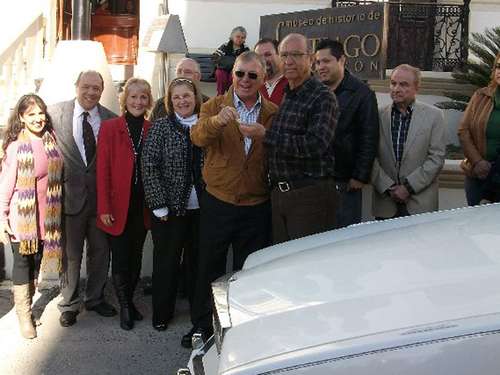
Alfred Kelley over the keys of a float to Bladimiro Montalvo Salas, mayor of Santiago, Nuevo León. In the image-captured Jan. 18, also appears Sara Kelley (necklace), who along with Alfred is accused of pedophilia and flee from several countries Photo La Jornada


Sara Kelley, author of a manual of 762 pages used pederasty as a spiritual leader of the Children of God cult and accused several countries of sexual abuse against children has been found in Santiago, Nuevo León, a safe haven to further expand their indoctrination religious.

Founded more than 40 years, the cult has changed its appearance and name to evade justice: from 1978 to 1981 was called The Family of Love, from 82 to 94, Family, from 90 to 95, Transformation; 95 to 2003, he returned to use the Family, and now continue to expand in the world as the Family International.

In the mountains of Santiago, under the guise of an altruistic benefactors American couple, Prisca (real name Sarah) and her husband Alfred Kelley founded six years ago the civil partnership Aid for All, whose stated purpose is to support orphanages, schools and vulnerable groups in the region.

They live in the community of San Andres, a town in the Neighborhood, located at kilometer 256 of the road. The house on Quail Street and Avenue 22 is Birds in place a bell ring. The gardener opened the gate. In a wide expanse of land has a swimming pool, green areas, palapa, and four trucks, two with Texas plates, and the other with nomenclature of Nuevo Leon, and a mobile home.

In the distance, Sara Kelley, 61, looks out the front door of the house.Dodge, cautiously, slowly out, look outside, take some wood to fuel their fire and disappears. Her companion is approaching. Sara says his name. She is blond, is just 20 years old and pregnant.With rudimentary Spanish, the apology:It is very busy. Journalists can not attend .

In sheep's clothing

The associations of former Children of God say that Sarah Kelley is a senior leader of the sect. Fled from several countries beset by scandals of corruption of minors and other crimes. It is considered a dangerous pedophile and pederast. First believed to live in Brazil.Then, recent reports indicated that lived in Mexico somewhere .

The residents of the Neighborhood became suspicious of her and her altruism few months ago. Help For All, AC. The Family International was organizing events in schools and orphanages with the software Resistance Education Drug Abuse and Violence (Dare), which conducts the state Public Safety. Then related to the authorities of the municipality of Santiago, the local DIF, Caritas and the Lions Club. Over the past years have organized brigades to remote and needy communities in the mountains with U.S. medical and travel to Texas to collect donations of health equipment and supplies.

They present themselves as missionaries who serve the community of Nuevo León . They donated an ambulance, hospital beds and wheelchairs. On January 18 gave the mayor a hearse, they said, cost $ 500 and 5000 was sponsored by 25 friends. For the residents of the Neighbourhood were struck by the regularity of so-called bingo gringos who have been organizing in the village for poor children.

But what really blew some neighbors alerts were people who claimed to have belonged to the association and came to seek therapy with a psychologist at the resort. A neighbor who asked not to be identified for fear of reprisals, said: It is a cult. Already there are injured people.These guys, Sara and Alf, have a history of pedophilia in the United States and other countries and have been tried on many occasions in the absence and were found guilty. Sara is the editor and promoter of pedophilia these materials to be used within their communities .

Perverse History

In 1968, former evangelical pastor David Brandt Berg (1919-1994) founded the sect-Christian home in America. His doctrine, considered dangerous by the sexual exploitation of its members, is based on an interpretation of the Bible according to which sex-in its many different manifestations, including incest, is used to demonstrate the love of God.

Berg 30 years ago developed a particular method of recruitment of members based on the so-called flirty fish or fucking fuck . It is the preaching of the Gospel using sex between adults and children to win converts and make money forcing women to religious prostitution .

Berg, also known as Moses David, Mo, Father David, Dad and Grandpa made apocalyptic prophecies of the end of the world that were never fulfilled. He was accused of sexually abusing their daughters, granddaughters and disciples.

Sara Kelley was Ricky's nanny Davidito Rodriguez, son of the sect's current leader, Karen Zerby, Berg's and stepson. She recounts the abuses committed against children.

"At 20 months old, Davidito was excited when I wash his tail, his penis becomes erect and hard. Both are exciting, open your legs begging for more ... When playing on the floor, frequently open their legs for me to kiss his penis.Both like to go so far as to take people by the hand to make him sit on the floor, then spreads her legs to receive the same treatment, "writes Sara Kelley on pages 334/335 of the manual , which includes explicit photographs of abuse, a text that became the method of raising children of the sect.

Sara and Alf gave his own daughter Davida, born in 1976, Berg sex as a gift when she was five. She and Davidito are the protagonists of pedophile manual written by Sara, whose daughter was interviewed several years ago by Anderson Cooper on CNN.

Davida criticized the methods the group in 2005 after the suicide of RickyDavidito Rodriguez, who committed suicide after killing one of their nurses residing in the United States.

The leaders of the sect have lived hand to mouth. Karen changed her name to Katherine Rianna Smith, 4 November 1997 - and his partner Steven Douglas Kelly by Christopher Smith, according to the records of the victims of the group.

Most have lived in secret, locked up in the United States, United Kingdom, France, Spain, South Africa, Switzerland, Philippines, Japan, Canada, Portugal, Ecuador, Peru and Mexico, among other countries.

Berg and leaders who have replaced have been tried in several countries for sexual abuse against minors, among other crimes. They have always shown a great ability to evade justice.

In 1995, Judge Ward of the Supreme Court in London sentenced in absentia for his crimes: "There was widespread abuse of children and adolescents, perpetrated by adults, and such abuses were more frequent in the bosom of the family in society general.

"There is overwhelming evidence that the senior leadership of the group was guilty of sexual abuse of minors.

About Berg has the responsibility to propagate the doctrine that so wickedly misled his flock and injured the children , said the court ruling over 500 pages, which refers to the sect as The Family of Sex.

The costume

The Family International has tried to distance himself from its recent past, but has never renounced its guidelines. The practice of free sex among its members and customs swinger (swingers) are common, but always try to hide their methods to potential donors and organizations that relate to them and serve as a cover for their true interests.

For more delusional enough, the cult is to its members the wife , so you can engage in sexual relations with any member. Shown against relationships that do not agree to be open to the entire group. Performed the ceremony Sundaychurch of love , which is a Mass with singing and devotions that ends in a general orgy.

Alf and Sara Kelley has held meetings with the mayor substitute Santiago Montalvo Bladimiro Salas. denounces the presence of the sect with the mayor Edelmiro Cavazos and his team said he would act, but a few days later he was assassinated. Then I went with the new mayor, and they answered that there are currently addressing other priority issues, says one of the neighbors, who prefers to remain anonymous.

Questioned why they have not acted against Sara Kelley and why the DIF and other support to children continue interacting with it, and concludes: "She comes out in photos and videos of child abuse. There is an HBO documentary.The magazine Rolling Stone has published a report saying that is presumed to be somewhere in Mexico and, oh, surprise, is here in The Neighborhood. Why not stop? The concern is that in countries where there have been people in collusion with them because their modus operandi is sex, promiscuity and Mexico, where there is so degenerate, who give bread to cry. "


RELATED ARTICLES ON THIS BLOG:


UK survivor confirms mother's fears about abusive cult The Family International that tried to recruit her teen daughter


Author's debut novel draws on personal experiences growing up in abusive Children of God cult, a.k.a. The Family International


Miss World organizers fail to legally gag Mail & Guardian over article exposing Miss Indonesia's cult connections

Who is the Real Anti-Christian: the Atheist or the Fundamentalist Christian?

Enslaved by the cult of sex...for 25 years

Castleconnell area was base for child sex cult, claims victim

Violent sexual abuse, brainwashing and neglect: What it's like to grow up in a religious sect

The Making of a Twisted Sexual Theology: Q+A on "Jesus Freaks"

Underside of cult life emerges

The offspring of 'Jesus Freaks'

The Tragic Legacy of the Children of God

Not Without My Sister [book review]

Cult Activity in Uganda?

Cult Claims To Be "Living by the law of love"

Children of God: Haunted By a Dark Past

Child-Custody Deal Favors Escapee of Notorious Cult 'The Family' aka The Children of God

Cambodian NGO exposed as a charity front for The Family International cult

Member of San Francisco pop duo, Girls, is a survivor of notorious Children of God cult, a.k.a. The Family International

Survivor of abusive Children of God cult, Chris Owens of Girls is one cool musician

Teen died agonizing death from ruptured appendix while parents, relatives and church elders did nothing but pray for 3 days

Self-proclaimed prophets: Phillip Garrido, David Berg and Joseph Smith

Another self-proclaimed prophet who terrorized and sexually abused his cult followers

Child sexual abusers commonly turn to religion to rationalize their behavior

Tony Alamo controls followers from prison, but David Berg controls The Family cult members from the grave

Irish TV exposes cults in Ireland, interviews survivor of abuse in Children of God, now The Family International


17 Feb 2011

UK survivor confirms mother's fears about abusive cult The Family International that tried to recruit her teen daughter

The Telegraph  -  UK    February 17, 2011


Losing my New Religion

To believers they are liberating 'New Religions'. To others they are just dangerous cults. But who is right? 

By Clover Stroud


Celeste JonesImage 1 of 2
Celeste Jones   Photo: LAURA PANNACK


'Just a normal teenage girl, but in the wrong place at the wrong time,' is how Charlotte Wells describes the circumstances in which her daughter, Rachel, then 17, met Wayne, 24, a 'religious missionary' , in a shopping centre in Somerset two years ago.

Within moments of meeting, Wayne was dazzling Rachel with tales of foreign work, and qualifications, ranging from youth counselling and disaster relief to business management and interior design. For the following weeks Rachel and Wayne conducted a sexual relationship, which Rachel hid from her mother; by the time he left for America, citing visa reasons, Rachel had fallen passionately in love.

'I asked Rachel what was wrong, as she seemed down, and she told me she'd met someone, but he'd left. She said there was something I should know about him that I mightn't like.' Wayne, along with his parents and nine siblings, was part of the Family International, a 'Christian' fellowship preaching the Gospel internationally.

Its members live communally, following rules about whom they can marry and with whom they can have children. The Family has had various titles, but was formed in California in 1968 as the Children of God. Its leader, David Berg, encouraged sex between adults and children as the highest expression of God's love. Mired in controversy, it rebranded itself as the Family International, but stuck to its roots: its webpage still includes a tribute to David Berg, and the Family has never renounced his writings.

'I emailed Wayne asking him about this leader and his associations. Wayne replied there was "absolutely nothing wrong with David Berg" . Then I did everything you're not supposed to do when your child becomes interested in a cult, and went completely bananas,' says Wells.

Obtaining exact figures on the number of cults operating in Britain is hard, but Ian Haworth of the Cult Information Centre estimates that there are well over 500 extreme organisations that can be described as cults.

'Lots of organisations, from extreme therapy groups to so-called religious organisations, come under the definition of cult, but they all share similar characteristics,' says Howarth. 'Broadly, a cult is as an elitist, totalitarian society which uses psychological coercion to recruit and retain members, isolating them from their family and society. Cults are led by self-appointed, messianic leaders who are non-accountable but often charismatic, and who also exploit their members.'

The danger of cults is that most of us don't realise how powerful they are, and the effects they can have. 'Part of the problem I faced was convincing other people I wasn't mad, and that Rachel really was in danger,' says Wells.

But Wells' anxiety was well founded, as Celeste Jones, 35, can testify. Jones was born into the Children of God. Her parents separated when she was four, and while her younger sister returned to England with her mother, Jones remained with her father in the cult throughout her childhood and into early adult life.

During this time she had five different names, and lived in 15 different countries – the Family prefers its members not to put down roots and is also keen to avoid the attention of suspicious locals and police.

Sex was a regular part of life, with adults openly having sex in front of children. A weekly dance would include every adult pairing off for sex, including children over the age of 12, and daily prayer sessions incorporated 'Cuddle Time' , or group sex. Jones was regularly assaulted by adult men in the name of God's love and, aged 11, was instructed to have sex with another child as part of the commune's 'date schedules' .

Now working as a family support worker for a children's charity in Bristol, where she lives with her 12-year-old daughter, Jones is composed and articulate. She explains that a cult survives by destabilising the natural order of parent/child relationships.

'In a cult your parents are not your parents, as everyone under the leader is a child who can be punished.' I ask her why she didn't complain to her father. 'I adored my dad, but rarely saw him for more than a few moments at a time past the age of five, as he was working for the group, and was often away. I was looked after by carers,' she says.

'Time with him was precious, so we were prevented from real communication. If I told my peers they might have ratted on me, which we were encouraged to do. I had a deep desire to please God and had been convinced that criticising the group was the devil speaking. If I was negative I'd get in trouble with the leader.'

To an outsider, it is difficult to understand why someone would join, or remain inside, an abusive cult, but Jones likens it to a woman being in a violent relationship she cannot leave.

'As anyone who has experienced domestic abuse will know, leaving that relationship isn't straightforward,' she says. 'I was brainwashed to believe what we were doing was right, and the world was wrong. And, as in an abusive relationship, I sometimes felt that, if I could only alter things from the inside, I could make the group better.'

Dr Alexandra Stein, a lecturer at Birkbeck College in London and a social psychologist specialising in extremist groups, experienced at first hand the emotional complexity of life in a cult. An engaging woman in her late fifties, Stein spent a decade under the control of a radical Marxist group, O, in Minneapolis from the age of 26.

It's hard to imagine Stein being the kind of weak, lost individual one imagines might get sucked into a cult. But Ian Haworth suggests the easiest people to recruit are, in fact, intelligent, educated, idealistic and economically advantaged.

When she joined O, Stein had witnessed the Vietnam War and the rise of feminism, and had a hunger for political activism. 'The group didn't present itself as an organisation that would remove my ability to make personal choices, or control my entire life. Instead, it seemed like a bunch of like-minded, friendly people who impressed me with details of their healthcare clinic and campaigning they'd done for women's rights.'

Gradually, Stein became more involved with the group, and moved into a flat with several members. The group removed all her personal freedoms; she had an arranged marriage and was instructed not to use her diaphragm.

'Right away I was ordered to have kids as a way of controlling me,' says Stein. 'By this time I was isolated from friends and family. I was given a memo about my contraceptive choices on a beige sheet of paper, and obeyed it.

'I was a committed feminist, but I was brainwashed, so my thought process was confused, allowing the organisation to make highly personal choices for me. This "disorganised attachment" also happens in an abusive relationship, when a woman is confused and intimidated, then isolated to the point that the only person she can turn to is her abuser.'

For Jones and Stein, having children proved the turning-point, and they both escaped from their cults. 'Seeing the organisation with the eyes of a mother protecting her child helped me to distance myself from it,' Stein says. 'I reached breaking-point when I was instructed about the type of toys my kids could play with, as cartoon characters were forbidden. It seemed so absurd.'

Determined to break the conspiracy of silence that surrounds cult membership, both women have since published accounts of their experiences – Jones in Not without My Sister, Stein in Inside Out – and have been instrumental in setting up the Safe Passage Foundation, which provides resources and support for people raised in cults. The Cult Information Centre and the Families Survival Trust are another two organisations offering support to people affected by cults.

These organisations all agree that it's an escalating problem. In addition to the Family, Ian Haworth cites the Moonies as 'a force to be reckoned with' , and is critical of the growing number of therapy cults, 'which can be equally abusive by using psychological coercion to control members' .

Also active in Britain is the Church of Scientology, founded by L Ron Hubbard in New Jersey in 1952, which boasts many high-profile members in Hollywood, including Tom Cruise, Katie Holmes and John Travolta.

The Church of Scientology denies it is a cult – and Scientology is recognised as a religion in a number of countries, including America, but not Britain. ('Is Scientology a cult?' asks the organisation's website. 'No. It is a religion in the fullest sense of the word.')

There are many controversial aspects to Scientology, not least its belief that humans are descended from a race exiled from another planet in the distant past. There is also the issue of 'disconnection', a term used by Scientologists to describe the withdrawal of contact with friends and family who, in the words of the website, '[are] suppressive or who [are] antagonistic to Scientology or its tenets'.

The website continues: 'In order to resolve this situation, one either "handles" the other person's antagonism with true data about Scientology and the Church or, as a last resort, when all attempts to handle have failed, one "disconnects" from or stops communicating with the person.' Opponents of Scientology argue that disconnection is a sinister instrument employed to drive a wedge between members of the organisation and their families. The Church of Scientology rejects these claims.

Silene looks like any other well-heeled middle-aged lady in the leafy English suburb where we meet for coffee. Speaking with a lyrical Brazilian accent, she tells me about her intelligent daughter Natalie, and their once loving relationship.

'Natalie was so close to both me and my husband, and we often got together as a family,' she says. Natalie spent much of her twenties teaching English abroad, before moving back home aged 27 and taking a job in the City. Silene was alarmed to find books on Scientology in Natalie's room. 'I asked her if she was involved and she said she would never be involved with Scientology as she didn't believe in it.'

Yet during 2009 Natalie became distant. 'It was as though she was carrying a terrible burden about with her,' says Silene. 'She became serious and tense.' By the end of last year Natalie moved out to live with other Scientologists, and started seeing Anton, whose stepfather John, sister and mother are all involved with Scientology.

Relations with Natalie became strained, and at Christmas that year she tipped a table of food over her parents when Scientology came up in conversation. 'It was so unlike our daughter, like she'd been taken over.'

Last April Silene and her husband met Anton's family for lunch, unaware of the extent of their involvement with Scientology. Soon afterwards John arrived, uninvited, at Silene's house. 'He shouted that if I didn't accept Scientology, Natalie would disconnect.' Shortly afterwards Natalie stopped communicating with Silene.

The organisation is generally extremely uncommunicative with families who contact them for information about relatives who have joined. Many parents whose children are members report a 'wall of silence' , with letters, emails and phone calls all going unanswered.

But when I contacted it to ask about Natalie someone responded immediately, telling me that Natalie 'has had issues with her mother that go back well before she became a Scientologist. She decided earlier this year to let matters cool off for a period, but she did not disconnect from her. She has been in good communication lately with her mother and is hopeful that they will have good family relations going forward.'

Shortly afterwards Natalie called Silene, and has seen her, although they cannot talk about Scientology. 'I have only seen Natalie a couple of times, and we don't mention it, as it causes huge fights. And I will go on fighting, for as long as it takes, to get her out.'

Charlotte Wells' fight to prevent Rachel joining the Family International came at significant personal cost. She took six months off work, using the time to educate herself about the way a cult works. 'Fighting a group like this is intimidating, and I had to learn fast,' she says.

Her persistence paid off. Rachel started questioning the fact that marriage to Wayne would involve living within an enclosed group. 'When she could look at it calmly Rachel started examining what Wayne had told her. She didn't like the idea that she would have to live communally with other members of his group,' explains Wells.

'She was a teenage girl with romantic notions about living with and marrying Wayne, as she really believed she had fallen in love. When we talked about this and it was clear that it might not just be the two of them, she started to get cold feet. She was upset about the idea that she would have to join the Family in order for them to have a sexual relationship together, and I think that this realisation made it all seem a lot less romantic and exciting.'

Eventually, Rachel dropped her plans to move to America, and today mother and daughter rarely talk about the episode.

'I'm positive that, had she joined Wayne, she would have been coerced into joining the group as soon as her feet hit the runway,' says Wells. 'Then she would've been lost to me, perhaps forever. It frightens me to think what her future might have been like. It's left a scar too, as I know it's something I have to be vigilant about as it could happen again, at any time.'


This article was found at:


RELATED ARTICLES:


Author's debut novel draws on personal experiences growing up in abusive Children of God cult, a.k.a. The Family International


Miss World organizers fail to legally gag Mail & Guardian over article exposing Miss Indonesia's cult connections

Who is the Real Anti-Christian: the Atheist or the Fundamentalist Christian?

Enslaved by the cult of sex...for 25 years

Castleconnell area was base for child sex cult, claims victim

Violent sexual abuse, brainwashing and neglect: What it's like to grow up in a religious sect

The Making of a Twisted Sexual Theology: Q+A on "Jesus Freaks"

Underside of cult life emerges

The offspring of 'Jesus Freaks'

The Tragic Legacy of the Children of God

Not Without My Sister [book review]

Cult Activity in Uganda?

Cult Claims To Be "Living by the law of love"

Children of God: Haunted By a Dark Past

Child-Custody Deal Favors Escapee of Notorious Cult 'The Family' aka The Children of God

Cambodian NGO exposed as a charity front for The Family International cult

Member of San Francisco pop duo, Girls, is a survivor of notorious Children of God cult, a.k.a. The Family International

Survivor of abusive Children of God cult, Chris Owens of Girls is one cool musician

Teen died agonizing death from ruptured appendix while parents, relatives and church elders did nothing but pray for 3 days

Self-proclaimed prophets: Phillip Garrido, David Berg and Joseph Smith

Another self-proclaimed prophet who terrorized and sexually abused his cult followers

Child sexual abusers commonly turn to religion to rationalize their behavior

Tony Alamo controls followers from prison, but David Berg controls The Family cult members from the grave

Irish TV exposes cults in Ireland, interviews survivor of abuse in Children of God, now The Family International